MCoating International | The noise spectrum in Marine Vessels: A solution for every wave.
MCoating International | The noise spectrum in Marine Vessels: A solution for every wave.
Noise on board a vessel is not a single phenomenon: it is the sum of different sources, frequencies, and propagation paths.
Engines, pumps, compressors, ventilation systems, transmissions, propellers, and cavitation phenomena generate vibrations that can propagate through the vessel structure and develop into structure-borne noise, i.e. noise transmitted through the structure and subsequently radiated into the surrounding spaces.
Understanding where the noise originates, at which frequency it occurs, how it travels through the structure, and how it is amplified is the first step in selecting the most effective damping system.
EXCITATION → STRUCTURAL VIBRATION → ACOUSTIC RADIATION → PERCEIVED NOISE
The main sources of noise on board include:
• main and auxiliary engines;
• pumps and compressors;
• transmission systems and mechanical movements;
• ventilation systems and air ducts;
• vibrations generated by technical equipment and transmitted to decks, bulkheads, hull plating, and stiffeners;
• cavitation generated by propellers and hull appendages, particularly dependent on operating and navigation conditions.
In the case of structure-borne noise, the vibration originates at the mechanical source, enters the structure, and is subsequently radiated as noise into the surrounding spaces.
Every vessel component has its own natural frequencies. When the excitation frequency approaches one of the structure's natural frequencies, resonance may occur, resulting in a significant increase in vibration amplitude.
But let's take it step by step.
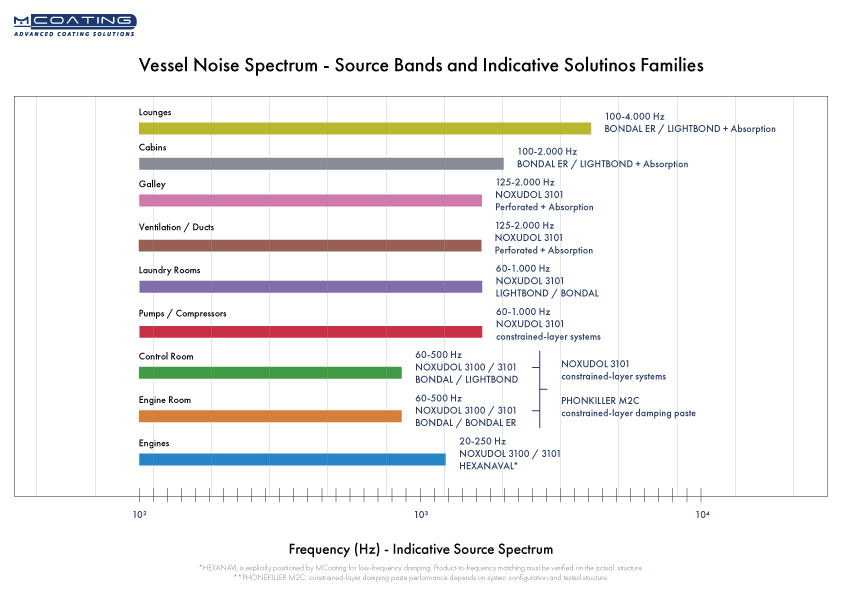
The frequencies indicated below provide an indicative technical overview of the main sources and onboard environments. The actual acoustic spectrum must be verified for each individual project through measurements and vibro-acoustic analysis.
| Source / Environment | Indicative Range |
|---|---|
| Engines | 20–250 Hz |
| Engines Room | 50–500 Hz |
| Engine Control Room | 60–500 Hz |
| Pumps and Compressors | 60–1,000 Hz |
| Laundry Rooms | 60–1,000 Hz |
| Ventilation / air ducts | 125–2,000 Hz |
| Kitchens | 125–2,000 Hz |
| Cabins | 100–2,000 Hz |
| Lounges / Salons | 100–4,000 Hz |
Low frequencies are particularly critical because they can excite large and rigid structures and propagate efficiently through structural elements.
For this reason, addressing noise on board does not simply mean “absorbing sound”: in many cases, it is necessary to control vibration at its source and along its structural transmission path.
A structure does not respond in the same way to all frequencies.
When the excitation frequency of a source approaches the natural frequency of a panel, deck, bulkhead, or other structural element, the response can increase significantly. This is the phenomenon of resonance.
Damping acts precisely on this phenomenon: by dissipating part of the mechanical energy as heat, it reduces the vibrational response and therefore the amount of energy that can be radiated as noise.
A viscoelastic material works by converting part of the mechanical strain energy into thermal energy, thereby reducing the energy available to sustain the vibration.
One of the parameters used to describe the dissipative behaviour of a material is the loss factor, η.
In simplified terms, the loss factor expresses the ability of a system to dissipate mechanical energy during a deformation cycle.
The loss factor is a parameter typically ranging from 0.01 to 1.
The loss factor depends on frequency, temperature, thickness, substrate, and system configuration.
A general reference can be represented on an indicative scale:
η ≈ 0.01 → very low damping
η ≈ 0.10 → significant damping
η ≥ 0.30 → high dissipative capability
These values should not be interpreted as universal performance thresholds.
In other words, there is no single “best” material: there is the most appropriate system for the specific frequency, structure, and operating condition.
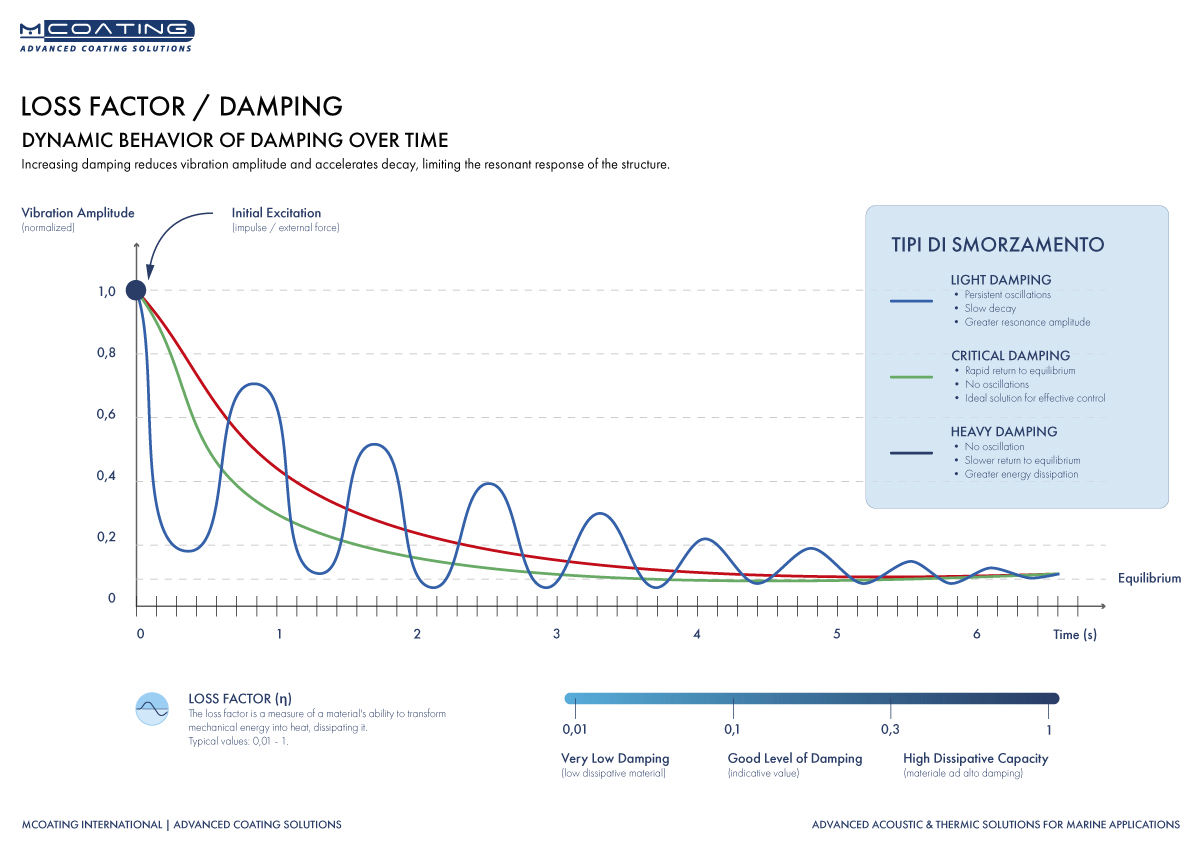
Effect of damping on vibrational response over time. For the same initial excitation, increasing damping progressively reduces the amplitude of the oscillations and accelerates their decay towards equilibrium.
Damping design must start from the actual noise spectrum.
The methodology can be summarised as:
Measure the spectrum → Identify the source → Control resonance → Dissipate energy.
In simplified terms, the noise spectrum can be divided into different frequency ranges, and for each range the most appropriate damping solution can be identified.
Low frequencies → control of structural vibrations and resonances
Mid frequencies → damping of panels and radiating surfaces
Mid-to-high frequencies → combination of damping, isolation, and acoustic absorption
At MCoating International, we offer different systems for noise damping: applying solutions directly to the structure, creating constrained-layer configurations, using sandwich panels, or integrating damping with finishing systems.
The question we ask is:
Which frequency do we need to control, and through which path does it propagate?
The answer makes it possible to define the most appropriate system: viscoelastic coating, constrained-layer damping, sandwich panel, ultra-lightweight solution, or a combination of damping and acoustic absorption.
|
System | Application Method | Area / Element | Field of Application |
|---|---|---|---|
| NOXUDOL 3100 | Viscoelastic Coating | Hull, metal panels, ducts, structural surfaces | Vibration damping / structure-borne noise |
| NOXUDOL 3101 | Viscoelastic Coating | Hull, decks, bulkheads, structures, technical spaces | Structural damping; particularly suitable where fire-safety requirements apply |
| HEXANAVAL ALU / STEEL | Self-Adhesive Sandwich Plate | Structural elements and surfaces subject to low frequencies | Low-frequency structural damping |
| BONDEL / BONDAL ALU / STEEL | Sandwich Panel | Engine rooms, technical areas, bulkheads, decks, and finishes | Damping integrated into the structure/panel |
| BONDEL / BONDAL ER | Sandwich Panel / Finishing Element | Walls, ceilings, technical areas, and interior spaces | Integration of damping and finishing |
| LIGHTBOND | Ultra-Lightweight / Sandwich Panel | Secondary walls, suspended ceilings, and finishing systems | Damping with a focus on weight reduction |
| PERFORATED PLATES | Perforated Sheet / Counter Plate | Suspended ceilings, linings, systems incorporating insulation | Constrained damping and integration with sound-absorbing materials; perforation also enables application according to the Helmholtz principle |
Effect of damping on vibrational response over time. For the same initial excitation, increasing damping progressively reduces the amplitude of the oscillations and accelerates their decay towards equilibrium.
The solutions can be integrated into different parts of the vessel:
BULKHEADS · DECKS · HULL PLATING · STIFFENERS · CEILINGS · AIR DUCTS · ENCLOSURES · ENGINE ROOMS · GENERATORS · TECHNICAL ROOMS
Particular attention should be paid to stiffeners and panel spans: the geometry, stiffness, and dimensions of the element can significantly influence its natural frequencies and, consequently, its vibrational response.
MCoating International is a Dutch-Italian Company providing innovative solutions for the Marine, Superyacht, Offshore and Industrial sectors.
Our expertise includes Thermal and Acoustic Insulation, Anticondensation, Passive Fire Protection, Antifouling, Corrosion Protection and Lightweight Insulation Panels for Engine Rooms and Technical Spaces.
More than coatings, we deliver complete Marine Performance Systems designed to improve Comfort, Safety, Energy Efficiency and Durability while reducing Weight, Maintenance and Operating Costs.
Combining Advanced Materials, Engineering Support and Practical Experience, we help Shipyards, Owners and Contractors find the most effective solution for every project.
Need advice for your next project? Contact our specialists today..

Laagraven 5D
3439 LG Nieuwegein
Utrecht - NL
KvK: 57563071
BTW: NL002525552B18
©2004- MCoating | Advanced Coating Solutions - All Rights Reserved | Credits |